Best Time to Take Whey Protein for Muscle Gain
-
 Abhinav
 - Posted on
- 0 comments

Ask five different people at your gym when you should take whey protein and you’ll likely get five different answers. Right after your last rep. Thirty minutes before training. First thing in the morning. Right before bed. One guy will insist the exact minute matters. Another will say it doesn’t matter at all.
The truth, as usual, sits somewhere in the middle — and it’s more nuanced than most supplement labels would have you believe.
This blog covers what the science actually says about whey protein timing, when it genuinely makes a difference, and when you’re probably overthinking it. For the full picture of how whey protein works in your body, start with our Complete Guide to Whey Protein: Benefits, Types & How to Choose.
Now, let’s dive into Best Time to Take Whey Protein for Muscle Gain:
First, the Most Important Thing to Understand
Before we talk about timing, here’s the single most important point about protein and muscle gain: total daily protein intake matters far more than when you consume it.
If you’re eating 80g of protein a day when your body needs 150g, it doesn’t matter whether your post-workout shake is consumed at 6:32 PM or 7:15 PM. The gap in total intake is the real problem.
Get your daily protein requirements sorted first. Everything else — including timing — is fine-tuning on top of a solid foundation. Speaking of which, check out our detailed blog on How Much Protein Do You Really Need Daily? to nail down your personal targets.
The Post-Workout Window: Real, But Wider Than You Think
The concept of the “anabolic window” — the idea that you must consume protein within 30 minutes of finishing your workout or the gains disappear — became wildly popular in the early 2000s and has stuck around ever since.
More recent and comprehensive research has significantly widened this window. A 2013 meta-analysis published in the Journal of the International Society of Sports Nutrition found that the anabolic window for muscle protein synthesis is likely several hours wide, not 30 minutes.
That said, there are still good reasons to prioritise post-workout protein consumption:
- Your muscles have just experienced significant stress and are primed to uptake nutrients
- Whey protein, being fast-digesting, delivers amino acids to muscle cells rapidly
- Consuming protein soon after training reduces muscle protein breakdown and accelerates repair
Practical guidance: Aim to consume 25–35g of whey protein within 1–2 hours of completing your workout. This is well within the effective window and gives you flexibility if you need to shower, commute, or finish cooling down first.
Morning: Breaking the Overnight Fast
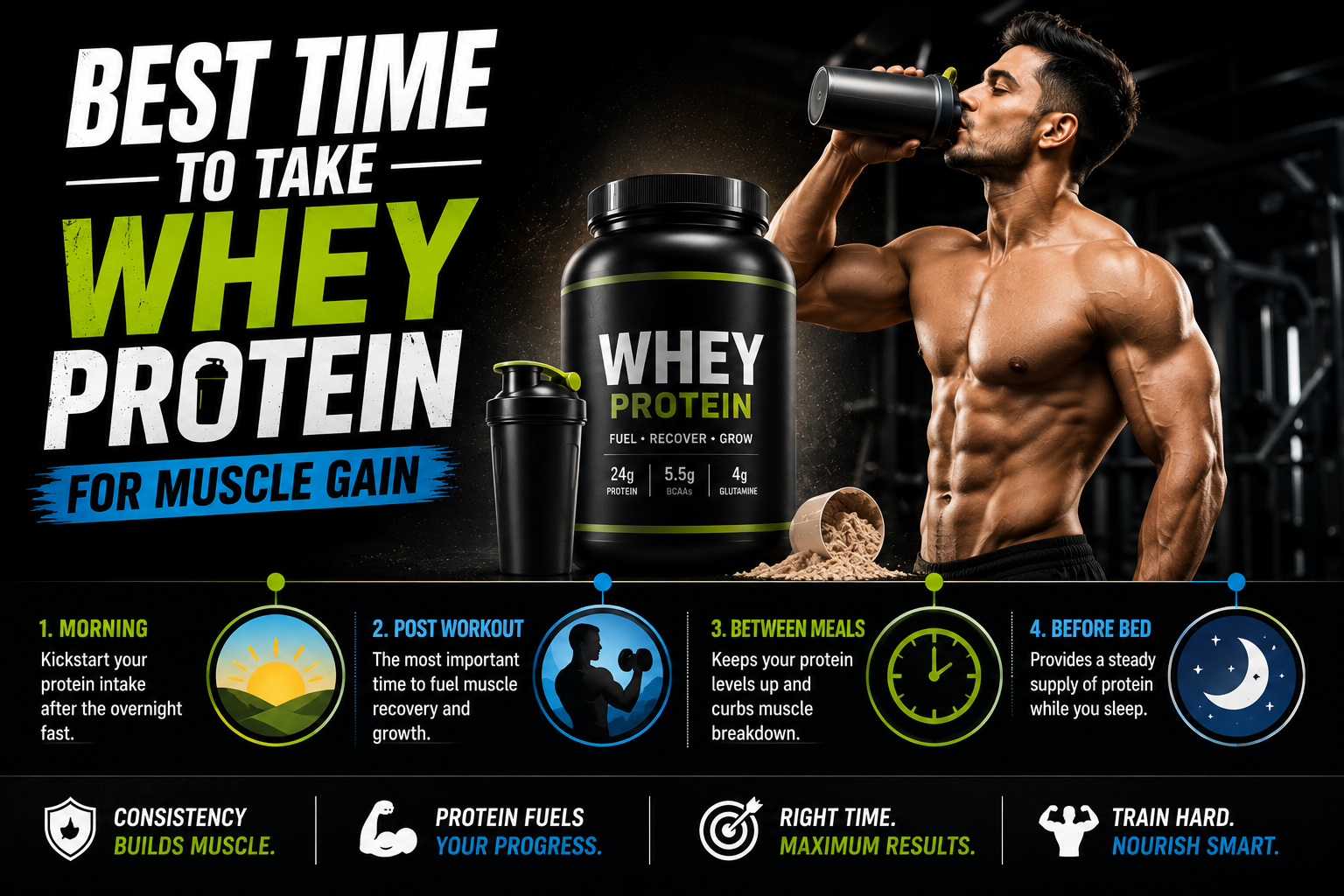
Your body goes 7–9 hours without food during sleep. By morning, muscle protein synthesis rates are lower, and your body may be drawing on muscle protein for energy in a mild catabolic state.
A morning protein shake — even just 20–25g — can help reverse this, kickstart muscle protein synthesis for the day, and set a strong protein baseline before your first meal.
This is especially relevant if:
- You train first thing in the morning on an empty stomach (fasted training)
- Your breakfast is typically low in protein (toast, fruit, tea — common in Indian households)
- You have a long gap before your first full meal of the day
Pre-Workout: Is It Worth It?
Taking whey protein before training has some evidence behind it, particularly for people who train early morning or who haven’t eaten in several hours before their session. Ensuring amino acids are available in your bloodstream during training can reduce muscle breakdown.
However, whey’s fast digestion can occasionally cause discomfort mid-workout if taken too close to training. 30–45 minutes before training is a reasonable pre-workout protein timing if you choose this approach.
Before Bed: Whey or Casein?
Here’s where whey protein is actually not the best choice. During sleep, your body undergoes significant muscle repair — but whey is absorbed and cleared from your system within 90 minutes. For overnight recovery, you want a slow-releasing protein that feeds your muscles across 6–8 hours.
Casein protein — the slower-digesting milk protein — is specifically designed for this purpose. Alternatively, a high-protein whole food like Greek yoghurt, cottage cheese (paneer), or a glass of whole milk before bed serves the same function more naturally.
A Practical Daily Timing Blueprint
| Time | Recommendation |
|---|---|
| Morning (post-sleep) | 20–25g whey protein to break overnight fast |
| Pre-workout (if fasted) | 20–25g whey protein, 30–45 min before training |
| Post-workout | 25–35g whey protein within 1–2 hours of training |
| Between meals | 1 scoop if daily targets are not being met through food |
| Before bed | Switch to casein or a slow-digesting whole food |
The Real Takeaway
Timing is a tool, not a rule. If hitting your total daily protein intake is the priority (and it should be), when exactly you consume your whey protein is secondary. But if your nutrition is already dialled in and you want to optimise further — post-workout and morning are your two highest-leverage windows.
Browse our verified whey protein range at Kapoor Medical Hall and find the right product to fit your routine.